
Best Liquid Magnesium for Absorption Compared
Posted by James Silverton on
Quick Summary
The best liquid magnesium for absorption is one that uses a highly soluble form, such as magnesium citrate, and clearly states elemental magnesium per serving. Liquid format alone does not guarantee better absorption, so check the compound and the milligrams delivered.
- Forms that dissolve well in liquid, such as aspartate, citrate, lactate and chloride, generally have higher absorption.
- Liquid magnesium citrate is highly water-soluble and often described as bioavailable, but it can loosen stools at higher doses.
- Convert ppm to elemental milligrams by multiplying ppm by 0.005 to get milligrams per teaspoon.
- Compare products by cost per 100 mg of elemental magnesium, not by bottle price.
- Dilute concentrated liquids in at least 8 oz of water or juice, and talk to a healthcare professional if you take medication.
Table of Contents
- Best Liquid Magnesium for Absorption Compared
- What Makes Magnesium Absorbable: Form and Solubility
- Liquid Magnesium vs Capsules and Tablets
- How to Read Elemental Magnesium per Serving
- Angstrom Magnesium Liquid Lineup Compared
- Magnesium Glycinate Liquid: What to Check on the Label
- Dosing, Taste and Safety Considerations
- Choosing Your Liquid Magnesium Next Step
- Frequently Asked Questions
Best Liquid Magnesium for Absorption Compared
Last Updated: November 7, 2026
What Makes Magnesium Absorbable: Form and Solubility
Magnesium absorption depends less on whether a product is liquid and more on the form of magnesium it contains and how well that form dissolves. At Angstrom Minerals, we compare liquid magnesium options with that rule in mind, because a bottle that is easy to drink does not automatically deliver more magnesium to your body. The National Institutes of Health states that NIH Office of Dietary Supplements magnesium fact sheet on forms that dissolve well in liquid generally have higher absorption, and it lists aspartate, citrate, lactate, and chloride among them.
A systematic review also describes magnesium citrate as one of the more bioavailable forms, noting its high water solubility (systematic review and meta-analysis on magnesium forms and bioavailability). This is the core reason many shoppers look for a most absorbable form of magnesium rather than a generic label.
Form matters for tolerability as well. A 2024 comparative clinical study reported that a greater proportion of participants experienced increased bowel movements with magnesium oxide and magnesium citrate than with the Mg-MS comparator (comparative clinical study on magnesium absorption and side effects). Higher absorption does not always mean better tolerability, so both factors belong in your decision.
Liquid Magnesium vs Capsules and Tablets
Liquid magnesium can be easier to measure in small increments and easier to swallow than a large tablet, which may matter for people who have trouble with pills. Those are usability considerations. They are not, by themselves, proof of faster or greater absorption.
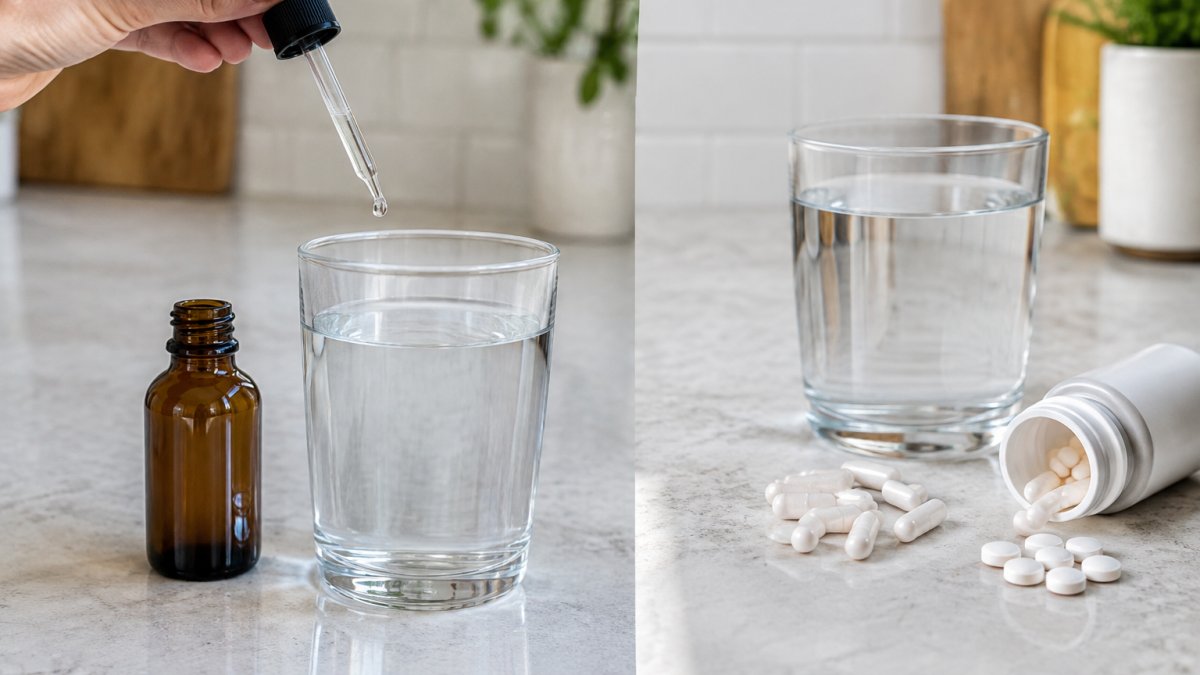
The reason is that absorption is driven mainly by the magnesium compound and the dose delivered to the intestine, not by the physical state of the product at the moment you swallow it. The National Institutes of Health Office of Dietary Supplements notes that forms that dissolve well in liquid tend to be absorbed well and lists magnesium aspartate, citrate, lactate, and chloride among them (NIH Office of Dietary Supplements magnesium fact sheet).
What liquid format can change is how precisely you can titrate a serving and how much water you take with it. A liquid measured by teaspoon or dropper lets you start at a fraction of a full capsule dose, which is useful when you are testing tolerance. Taking magnesium with water also matters because fluids help move the dose through the stomach and into the small intestine, where most magnesium is absorbed.
A comparison of liquid formulations is more useful than liquid versus solid as a category. Several liquid types are common on the shelf, and they behave differently:
-
Liquid magnesium citrate. Citrate is highly water-soluble and is one of the forms most often described as bioavailable in the research literature (systematic review and meta-analysis on magnesium forms and bioavailability). It also draws water into the bowel, so a meaningful share of users notice looser stools at higher doses. A 2024 comparative clinical study reported more frequent increases in bowel movements with magnesium oxide and magnesium citrate than with an Mg-MS comparator (comparative clinical study on magnesium absorption and side effects).
-
Liquid magnesium glycinate. Glycinate binds magnesium to the amino acid glycine. It is commonly chosen by people who want a form associated with calm rather than bowel urgency, but liquid glycinate products vary widely in how much elemental magnesium they actually deliver per serving. Check the milligrams per serving, not the form name.
-
Ionic or trace-mineral liquid magnesium. These products often list concentration in parts per million (ppm) rather than milligrams, which makes cross-shopping harder. You have to convert ppm to elemental milligrams per serving before any comparison is fair.
A practical way to compare a liquid against a capsule is to calculate elemental magnesium per dollar of delivered dose. Take the elemental milligrams per serving from each label, divide the bottle price by the number of servings, and compare cost per 100 mg of elemental magnesium. That number, not the format, tells you which product is delivering more magnesium for your money.
Watch out: a liquid that tastes strongly salty or bitter can tempt you to chase it with a large glass of juice or a flavored drink, which adds sugar and calories you did not plan for. Measure the dose first, then dilute.
How to Read Elemental Magnesium per Serving
Elemental magnesium is the amount of actual magnesium in a serving. It is the only number that lets you compare two products fairly, and it is almost never the number printed largest on the front of the bottle. Compound weight, bottle size, and concentration ratings all describe something other than the elemental dose.
The label gives you three numbers to reconcile: the compound name (for example, magnesium citrate), the elemental magnesium in milligrams per serving, and the serving size. If a label lists only the compound weight, you cannot calculate the elemental dose without the compound's molecular weight, and most labels do not give you enough to do that. In that case, look for a supplement facts panel that states elemental magnesium directly, or contact the manufacturer.
Liquid products add a fourth wrinkle: concentration expressed in parts per million (ppm). To convert ppm to milligrams per teaspoon, use this relationship: 1 ppm equals 1 milligram per liter, and 1 teaspoon is about 5 milliliters, or 0.005 liters. So milligrams per teaspoon equals ppm multiplied by 0.005.
Worked examples from our own lineup:
- 3,000 ppm × 0.005 = 15 mg elemental magnesium per teaspoon.
- 9,000 ppm × 0.005 = 45 mg elemental magnesium per teaspoon.
- 62,000 ppm × 0.005 = 310 mg elemental magnesium per teaspoon.
Those conversions explain why the 16 oz and 32 oz Angstrom Magnesium products deliver the same 15 mg per teaspoon despite different bottle sizes, and why the 2 oz and 8 oz Miracle Mag products deliver 310 mg per teaspoon.
Once you have elemental milligrams per serving, apply a short scoring method before you buy:
- Dose accuracy. Does the label state elemental magnesium per serving, or only compound weight? A clear elemental number scores higher.
- Third-party testing. Look for a certificate of analysis or a testing seal from an independent lab. A product that publishes its testing is easier to trust than one that does not.
- Additives. Check for sugar, artificial sweeteners, preservatives, and unnecessary flavoring. A shorter ingredient list is easier to evaluate.
- Allergens. Confirm the product is free of the allergens you need to avoid, and check whether it is made in a facility that also handles them.
- Cost per elemental milligram. Divide the bottle price by total elemental magnesium in the bottle (servings × milligrams per serving). Compare that figure across products rather than comparing sticker prices.
A common pattern is that concentrated liquids look cheaper per bottle but cost more per elemental milligram once you run the math, while larger bottles of moderate-concentration products often win on cost per milligram. Running the calculation takes about a minute and prevents most bad purchases.
Watch out: ppm and milligrams are not interchangeable, and a product that advertises a high ppm without stating milligrams per serving is asking you to do the conversion yourself. If the label will not give you the elemental number, treat that as a reason to keep looking.
Angstrom Magnesium Liquid Lineup Compared
Here is how the Angstrom Minerals magnesium liquids compare on the details that matter most for shoppers. Prices are the starting prices listed on each product page.
| Product | Size | Elemental Magnesium | Starting Price | Best For |
|---|---|---|---|---|
| 32 oz Angstrom Magnesium | 32 oz | 15 mg per tsp (3000 ppm) | $34.95 | Daily use at a moderate dose |
| 16 oz Angstrom Magnesium | 16 oz | 15 mg per tsp (3000 ppm) | $20.95 | Trying the line at a lower cost |
| 32 oz Magnesium Xtra | 32 oz | 45 mg per tsp (9000 ppm) | $59.95 | Experienced users under professional advice |
| 2 oz Miracle Mag | 2 oz | 310 mg per tsp (62,000 ppm) | $24.95 | Concentrated dosing, small footprint |
| 8 oz Miracle Mag | 8 oz | 310 mg per tsp (62,000 ppm) | $55.95 | Concentrate buyers wanting more volume |
Size
The 32 oz Angstrom Magnesium has a moderate concentration of 15 mg elemental magnesium per teaspoon and a bitter, salty taste, which you should expect at every dose.

Standard Strength Options
The standard-strength products suit people who want a gentle starting point. The 16 oz Angstrom Magnesium and the 32 oz Angstrom Magnesium share the same 3000 ppm concentration, so the difference is volume and price per bottle. The 16 oz is the lower-cost entry point, while the 32 oz gives you more servings.

Concentrated and Xtra Strength Options
The 2 oz Miracle Mag and 8 oz Miracle Mag are concentrates. The label says to dilute them in at least 8 oz of water or juice before drinking. The 32 oz Magnesium Xtra is the strongest option in the lineup, at 9000 ppm, and its label says it is meant to be used under professional advisement with caution.
Magnesium Glycinate Liquid: What to Check on the Label
Magnesium glycinate is a common form, but the liquid versions in our research are not described with comparative absorption data. Check the label for the form name, the elemental magnesium per serving, and the serving size. If a product lists glycinate, confirm the milligrams per serving rather than relying on the form name alone.
Dosing, Taste and Safety Considerations
Start with the serving size on the label and do not exceed it without guidance. The 32 oz Angstrom Magnesium lists a dosage of 1/2 to 1 oz with 32 servings per container. Taste is bitter and salty, and the concentrates taste strongly salty, so dilution helps for most people.
If you want to know whether liquid magnesium helps with specific symptoms, read our dedicated article on whether liquid magnesium stops muscle twitches. It explains what the evidence does and does not support. Read the dedicated article on whether liquid magnesium stops muscle twitches before you decide.
Talk with a healthcare professional before adding magnesium if you take medication or manage a health condition.
Choosing Your Liquid Magnesium Next Step
Pick the form and the elemental dose first, then the bottle size that fits how often you will use it. If you want to test the line before committing, the 2 oz Miracle Mag is a lower-volume way to try a concentrate at $24.95. You can explore our full magnesium lineup at www.angstrom-minerals.com to compare sizes side by side.

Frequently Asked Questions
What form of magnesium is most absorbable?
Forms that dissolve well generally show higher absorption, according to NIH Office of Dietary Supplements guidance, which lists aspartate, citrate, lactate and chloride among them. Magnesium citrate is also described in a 2025 systematic review as one of the more bioavailable forms because of its high water solubility. Liquid format alone does not prove better absorption, so check the magnesium form on the label, not just the bottle type. Angstrom Minerals sells ionic liquid magnesium at www.angstrom-minerals.com, but its absorption claims are product marketing rather than comparative trial results.
Is liquid magnesium absorbed better than capsules or tablets?
The supplied research does not include a head-to-head trial showing that liquid magnesium is absorbed faster than capsules or tablets. Absorption depends largely on how well the magnesium form dissolves, which NIH guidance ties to form rather than dosage format. Liquids can be easier to dose in small amounts and may suit people who struggle with large tablets, though a 2024 comparative study found that some forms, including magnesium oxide and citrate, were associated with more bowel movements.
How much elemental magnesium is in a liquid serving?
Elemental magnesium is the amount of actual magnesium in a product, which can differ from the total weight of the compound. Angstrom Minerals lists 15 mg per teaspoon for its 3000 ppm Ionic Magnesium, 45 mg per teaspoon for Magnesium Xtra at 9000 ppm, and 310 mg per teaspoon for Miracle Mag at 62,000 ppm. Always compare the stated elemental amount per serving rather than the bottle size. Check the serving size listed on the label before comparing products, since servings per container vary across these bottles.
What should I look for on a liquid magnesium supplement label?
Look for the magnesium form, the elemental magnesium per serving, the serving size, the number of servings per container and any dosing instructions. Confirm that the product lists its ingredients and ppm concentration clearly. Angstrom Minerals' listings state ppm, elemental magnesium per teaspoon, dosage and servings per container, which makes side-by-side comparison straightforward. Consult a healthcare provider before use if you take medications or have a health condition, since this site does not offer individual health advice.

Share this post
- Tags: best liquid magnesium for absorption, best magnesium glycinate liquid, elemental magnesium per serving, liquid magnesium, liquid magnesium vs capsules, most absorbable form of magnesium